Description
A chance encounter with a former president. A classroom challenge that becomes a national moment. A decision that changes the fate of the world.
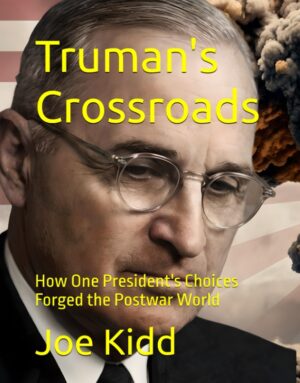
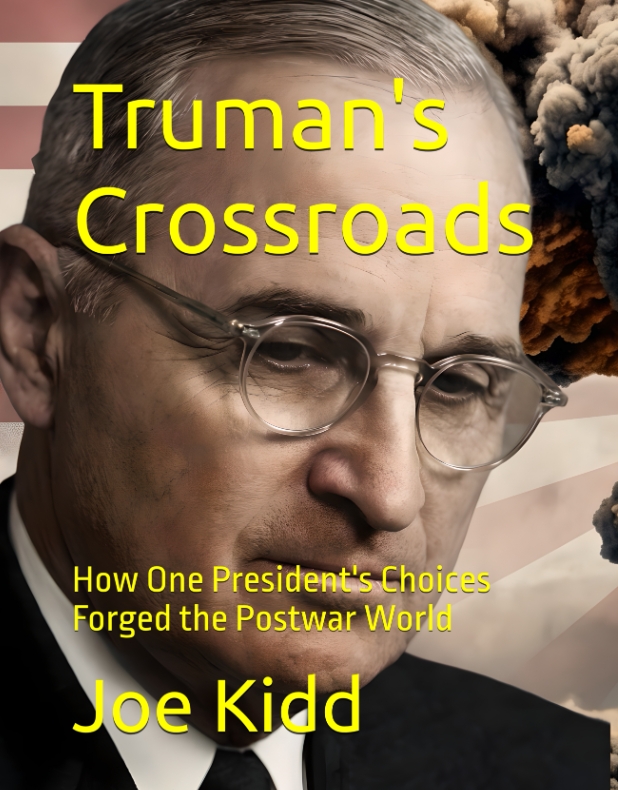
In Truman’s Crossroads: How One President’s Choices Forged the Postwar World, Joe Kidd braids meticulous history with an intimate, firsthand relationship to Harry S. Truman, bringing us inside the rooms—and the mind—where the twentieth century was remade.
The story begins far from the Situation Room, in a high school history class in Independence, Missouri. Assigned to write about a decision made by President Truman, a determined student secures permission to work in the restricted archive at the Truman Presidential Library—only to be caught there by Truman himself. What follows is a remarkable apprenticeship: days of recorded interviews, long conversations in a modest office beneath Thomas Hart Benton’s mural “Independence and the Opening of the West,” and an unexpected friendship between a plainspoken former president and a young conservative who lives just three blocks away.
When a disbelieving teacher fails the essay for lacking footnotes, that friendship comes to light. With a single phone call—“Mister President…”—Truman arrives at Truman High School in a small motorcade, steps into the classroom, and announces with a grin that he will serve as the students’ “feet and notes.” For seventy-five spellbinding minutes, he answers the very questions that anchor this book: Why did he authorize the atomic bombings of Hiroshima and Nagasaki? What alternatives were considered? What price, in American and Japanese lives, was he trying to avoid? In that compressed seminar, the moral calculus of 1945 becomes visceral, urgent, and unforgettable.
Those conversations, later continued in Truman’s office and over dinner with Harry and Bess in their unassuming Independence home, became the seed of Truman’s Crossroads. Drawing on transcripts, personal memories, and decades of subsequent research, Kidd reconstructs the world Truman inherited when he took the oath of office on April 12, 1945: a globe in flames, a war in its sixth year, an America exhausted but resolute, an Allied coalition straining under the weight of victory and the shadow of Soviet ambition. We are plunged into the rubble of Europe and the blood-soaked beaches of the Pacific, where every delayed decision promises thousands more dead.
From that wide-angle canvas, the book tightens its focus to the cramped rooms where history hung in the balance. Kidd invites us into a White House transformed into a crucible: the Oval Office still echoing with Franklin Roosevelt’s presence; adjoining spaces thick with cigarette smoke, urgent memos, and the relentless ticking of clocks that seem to count down to a decision no one wants to make but no one can avoid. Generals lay out casualty estimates for a full-scale invasion of Japan. Scientists explain the awful new power of the Manhattan Project. Allied leaders—Churchill pragmatic and weary, Stalin implacable and calculating—press their own visions onto the fragile scaffolding of postwar order.
At the center stands Truman: a former haberdasher and Missouri senator who has been vice president for only weeks, suddenly thrust into command of the most powerful war machine in human history and handed a weapon capable of erasing cities in an instant. Kidd portrays him not as an all-knowing strategist but as a man learning in real time—absorbing briefings, weighing counsel, and wrestling with a question that will not leave him: is it better to kill tens of thousands of Japanese civilians in an instant, or to lose hundreds of thousands of American and Japanese soldiers—and untold additional civilians—in a drawn-out invasion?
The book neither excuses nor condemns. Instead, it dwells in the discomfort. Kidd walks the reader through the “atomic question,” the deliberations that lead to “The Decision,” and the shattering aftermath in Hiroshima and Nagasaki—then follows Truman as he confronts what his choice has unleashed. We see the victory celebrations and the private misgivings, the public justification, and the quiet, enduring burden that settles on a man who has authorized a leap into the nuclear age.
Yet Truman’s Crossroads is not confined to August 1945. In its second half, the narrative widens again to show how Truman’s decisions shaped the world that followed. We follow him to San Francisco and the founding of the United Nations, where a new framework for global cooperation is hammered out amid mutual suspicion. We watch the Marshall Plan emerge from stacks of economic reports and late-night meetings into a bold effort to rebuild a shattered Europe and contain communist expansion without direct confrontation. We see the first contours of the Cold War harden as Stalin tightens his grip on Eastern Europe and the United States begins to define a long-term containment strategy.
Throughout, Kidd underscores a central paradox: the same presidency that authorized unprecedented destruction also helped construct the institutions and alliances designed to prevent a third world war. Truman’s tenure, in this telling, is less a straight line of “tough choices” than an ongoing struggle to reconcile power with restraint, necessity with conscience, and national interest with a wider responsibility to humanity.
What distinguishes Truman’s Crossroads from other Truman biographies is the way it blends the sweep of history with the intimacy of personal encounter. The boy who once sat over an old Royal typewriter, painstakingly drafting and redrafting his essay, becomes the historian-novelist who decades later can still recall the sound of Truman’s voice, the way he joked about being “the notes,” and the warmth of a dinner where Bess insisted on being called by her first name—even as the world outside reeled from decisions made under her roof.
Kidd never lets the reader forget that history is lived by real people. Cabinet arguments have the texture of human disagreement rather than abstract policy debate. Strategic memoranda carry the weight of the lives behind the numbers. Funeral scenes—Truman’s own, in the courtyard outside his library office—are rendered not as ceremonial endings but as the closing of a very personal chapter in the author’s life: a last visit to a friend whose story he is still, all these years later, trying to understand and to tell well.
For readers of narrative history, political biography, or anyone who has ever wondered what it truly feels like to sit at the apex of power when every path leads into unknown moral territory, Truman’s Crossroads offers an immersive, emotionally resonant journey. It asks us to step into a world trembling on the edge of annihilation yet yearning for renewal—and to consider, with Truman, how a single human being should act when no choice is clean, and every decision will echo through generations.
At a moment when questions of leadership, war, and the responsibilities of great powers are once again front-page news, this book holds up a mirror from 1945 to our own time. In the glow and shadow of those atomic flashes, and in the quiet resolve of a reluctant president, we may glimpse not only the forging of the postwar world, but the enduring trials of anyone who dares to lead in an age of unprecedented power.