Description
About the Book
Ten years after a miracle rose out of the Kansas prairie, the people who built it are about to learn what it costs to keep it honest.
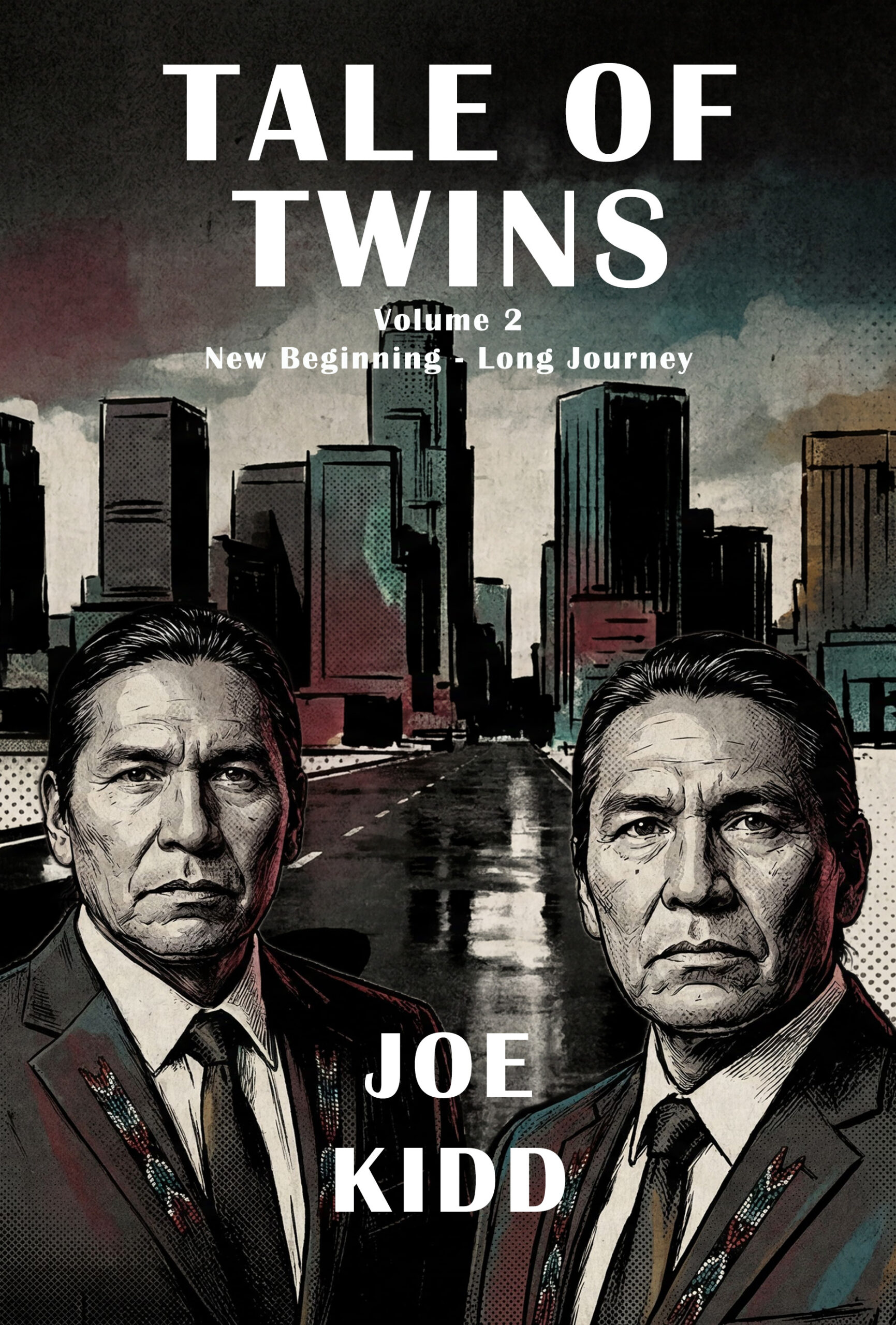
In Tale of Twins, Volume 2: New Beginning – Long Journey, the Lakota city of Amity has become the beating heart of a new world: a tribal‑led spaceport sending shuttles to orbit, a health system that outperforms federal platforms, and an underground engine of impossible wealth buried in the Cavern beneath the Flint Hills. Wakantankium, a reality‑bending mineral, a vast underground sea, and an oil reserve larger than anything on the surface have powered high‑speed obsidian rail lines, restored dying aquifers, and turned forgotten counties into thriving corridors. From the air, Amity looks inevitable now. On the ground, everything is more fragile than it appears.
Hana Lakota, once a young physician fighting for basic services, is now the public face of Amity Health—a system of thirty‑two facilities across twelve states, wired together by real‑time data and tribal governance. When a congressional delegation arrives to explore transferring the Indian Health Service into Amity’s hands, Hana stands in a glass‑walled conference room over the prairie and makes her pitch: a tribal‑led, publicly accountable alternative to a century of failure. But her real battle is inside the machine she helped build. When she demands a slower, story‑driven pathway for elders—and wins—she becomes visible in a new, dangerous way.
On a rooftop garden, elder William White Bear hands Hana a leather ledger full of names that don’t exist in any system: people treated off the books, outside the data, whose lives don’t survive being reduced to metrics. One of them, Eliza Two Hawks, “remembers things before they happen” and insists she is not confused. As Hana sits with her in a stone building that doesn’t show up on maps, she’s forced to confront a possibility she has spent a decade coding around: some of what matters most in Amity cannot be measured.
Far below, in the obsidian‑lined chambers of the Cavern, Hana’s twin Tommy listens to a different kind of data. The mining operation that began as a question has grown into an industry worth two quadrillion dollars, extracting gems, Wakantankium, and energy in carefully paced cycles. Tommy has always treated the Cavern as a relative, not a deposit—mapping its rhythms, insisting on precision that borders on ritual. Now the stone is speaking differently. Output curves no longer look like cycles; they look like a response. Unauthorized deep drilling punches through a raw vein, triggering a surge that drops people to their knees on the surface and sends a resonant fever through those most closely tied to the land.
Above ground, their cousin TJ has his own hum to read. A lawyer and banker, he sits in a glass office overlooking the spaceport, sifting through leases and shell companies until a familiar name emerges: Vanguard Industries, a conglomerate that never builds, only positions and takes. Vanguard is probing Amity’s edges through proxies like Red Mesa Logistics, quietly buying secondary mineral rights under seemingly inconsequential parcels. To stop them, TJ does the one thing the system can’t easily ledger: he creates a hidden Nevada LLC, funded with his own money, to cut them off before they consolidate control. It’s a brilliant countermove—and a line he may not be able to uncross.
As pressure builds, the family’s private world begins to fracture. Kam, carrying twins on a west‑facing porch her grandmother once used to watch the sun fall across the prairie, feels her babies move in sharp, synchronized bursts that feel less like growth and more like warning. She smells something acrid and electrical beneath the grass, and the vision of a white buffalo, ash, and changing sky takes hold. When the Cavern surges again, she collapses in her rooftop garden, clawing at the dirt as if trying to ground a current no monitor can see.
In the hospital, Hana does something she has avoided for years. She lays sage by Kam’s bedside—not as performative ritual, but as a quiet act of presence—and places her hand over Kam’s heart. She feels a second rhythm layered over Kam’s own, a hum that matches Tommy’s seismology and the flicker of blue energy in the Cavern. The twins are not just unborn children; they are amplifiers, carrying the land’s distress through their mother’s body. The worlds the family has tried to keep compartmentalized—medicine, mining, law, ceremony—have already merged.
The more Hana pushes for human‑centered care, the more corporate CEO Petr Thorne tightens his grip. Thorne is a predator who prefers to hunt in storms, watching the city from a dark office while data feeds show him where to press. In his drawer sits the Exile Protocol, a step‑by‑step plan for neutralizing the Lakota core of Amity if they ever become inconvenient. He’s also holding something older: Beneficial Advisory Rights agreements, signed years ago by William White Bear and Thorne himself, that brought conglomerate capital into the project long before there were rail lines, clinics, or votes. Whether that deal was a trap for capital or a compromise too far, it means the miracle city was built, at least in part, with snake money.
Down in the Cavern, Tommy realizes that the new surges aren’t geological accidents; they’re a warning. When an experimental disruptor device is deployed to silence the Heart‑Stone—the Cavern’s central, living core—the chamber becomes a battlefield. The beam collides with obsidian process marks etched into the walls, Hana and Sarah scramble to re‑route energy, and Raymond chants old words as the stone tries to adapt. Tommy ends up pinned under falling rock, legs trapped but body intact, understanding with painful clarity that he has become part of the Cavern’s neural network. He chooses to remain a brace, holding the Heart‑Stone steady at the cost of his own freedom.
On the surface, the Exile Protocol is triggered. Boards are dissolved. Accounts are frozen. Statements are drafted to cast the siblings as unstable threats to their own miracle. Hana is pushed out of Amity Health, her authority stripped and her reforms rolled back. She walks into an alley as a man’s arm burns with faint blue Wakantankium residue and treats him with mud, water, and memory, writing a symbol on the wall instead of a chart number. The death of Director Lakota is public and documented. The birth of Hana the healer is not.
TJ survives a shaft collapse, gripping Tommy’s hammer and, for the first time since childhood, weeping in the dark. When he reaches for his twin and finds only silence, he believes Tommy is gone—until he realizes he’s been looking in the wrong direction. Tommy is no longer a single point to be found; he’s a field woven through the stone. When TJ finally learns to reach down instead of outward, a new, disorienting form of connection opens.
As Founders Day approaches—a gala meant to celebrate Amity’s success and reassure investors, Congress, and the world that everything is under control—the siblings stop pretending they can fight on separate fronts. On an underground train humming through obsidian tunnels toward the city, Hana, Tommy, and TJ decide to turn the stage they’ve been given into a fault line. They plan to expose the hidden tiers that determine who lives and who is left to die, to tie those tiers to Vanguard’s emergency abuses, and to force the world to watch. They intend to reveal the Sacred Care clause that binds executive pay to elder outcomes, announce new protections any company must accept to operate in their footprint, and hint at Wwaake and other unpublicized truths the markets should be afraid to ignore.
They know what public confrontation will cost: exile, maybe worse. Founders Day becomes their line in the sand. If they stay silent, Kam and the twins remain unprotected conduits for a land being pushed past its limits, and Vanguard quietly rewrites the rules around them. If they speak, the war will no longer be theirs alone.
Tale of Twins, Volume 2 is a story about sovereignty and capture, about the seduction of clean dashboards in a world where some truths refuse to live in charts. It asks what happens when a tribal‑led miracle city becomes too valuable to be left to the people who dreamed it, and what people will sacrifice to stay in right relation with land, law, and each other. It is the long, difficult middle of a saga: the part where the miracle is already here, and the question is no longer whether it can be built, but whether it can stay honest without breaking the people who hold it.