Description
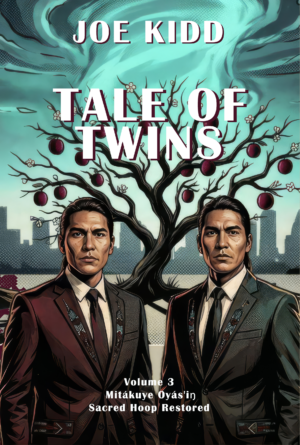
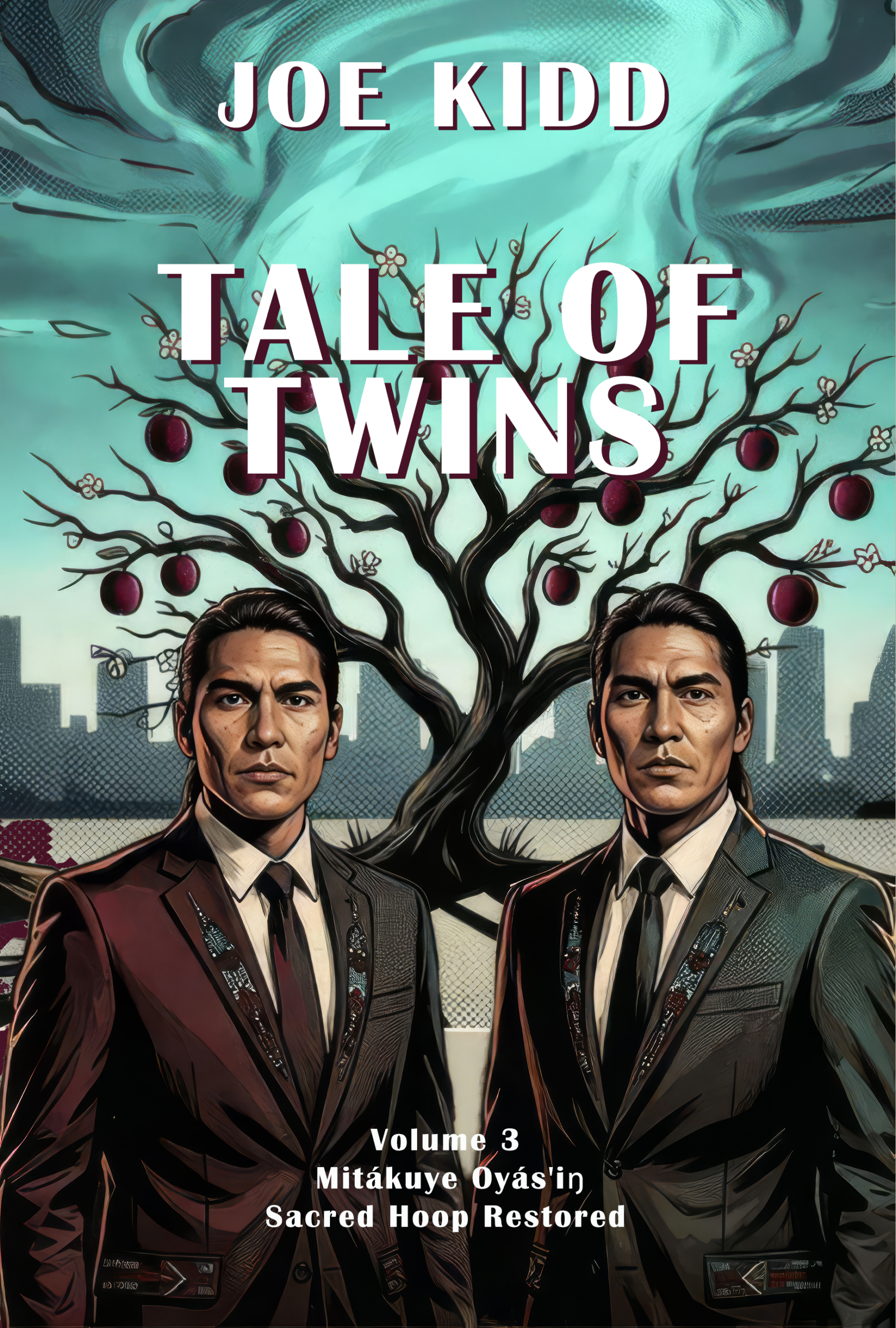
Tale of Twins: Volume Three
Mitákuye Oyás’iŋ – Sacred Hoop Restored
The crisis is over. The real work has just begun.
Amity, Kansas has survived. The Wakȟáŋtȟaŋkium Cavern has been recognized as a Living Patient under tribal and international law. The Sacred Care Accords have been signed. The refinery crisis is history, and history has been rewritten.
But history never stays written.
In the final volume of The Mercy of the Earth trilogy, the fifth generation of the Lakota-Jefferson twin lineage comes of age in a world their parents built and the planet is still testing. Thomas Jefferson Lakota and William Chee Jefferson were born into a covenant. Now they have to decide what it costs to keep it.
Thomas goes to the University of Kansas and learns that the most dangerous thing about power isn’t the people who want to take it from you. It’s the slow, patient drift of a system that was built right, run long enough, and gradually forgot why. He returns to Piyawiconi LLC not as a son but as a successor, inheriting a twenty-quadrillion-dollar fund, a two-hundred-thousand-strong Infrastructure Defense Corps, and a covenant that only works if someone keeps asking the question taped to the bottom of his monitor: Who pays for the shift?
William goes to the University of Texas and discovers that the most effective place to protect Amity’s values isn’t inside them. It’s in the rooms where people who’ve never heard of Sacred Care are deciding whether it gets to exist. He becomes a lawyer, a governor, a husband to the daughter of a Texas political dynasty, and eventually—through a constitutional succession nobody planned for—the President of the United States.
Between them, in the warm dark of the Cavern’s lower gallery, Tommy Lakota presses his hands to the stone and feels what the instruments can’t measure: that the Amity formation is not alone. Analogous Living Patients are waking in the Four Corners, beneath the Canadian Shield, in the Peruvian altiplano where a shepherd woman named Yana Mamani has been pressing her palms to a warm rock since before anyone thought to write down what she was feeling. And in the permafrost of Siberian Yakutia, something old and frightened and patient is beginning to hear the frequency that changed when the Sacred Care Accords were signed.
When coordinated nuclear attacks destroy both coasts—taking the federal government, the financial centers, and the colonial institutional apparatus that built them—the republic fractures along exactly the fault lines that Piyawiconi and the Sacred Care model were designed to outlast. The center has been destroyed. The question is what gets built in its place.
The answer, proposed by a president who grew up pressing his feet against the hum of a living stone, is radical, ancient, and already partially built: a new federal district in the interior of the continent, co-governed by Indigenous nations and the land itself, founded on the principles of the Sacred Care Accords and the Great Law of Peace of the Haudenosaunee Confederacy.
The Greater Circle.
But building the future requires facing the full weight of the past. The contamination zones on both coasts fall on Indigenous territories alongside the institutions that displaced them. The Siberian formation is under Russian jurisdiction, without community protection, watched by a network of relationships too fragile and too important to risk. The United Nations of America—a continental framework of sovereign nations, First Nations, and Living Patients governing their shared relationships with the land—is either the fulfillment of the Red Elk prophecy and the return of the White Buffalo Woman’s teachings, or it is a beautiful monument to what was intended rather than the thing itself.
That depends on whether enough people keep showing up.
The Greater Circle is the conclusion of an epic that spans five generations, three volumes, and the full breadth of what it means to build something worth inheriting. It is a legal thriller, a political saga, a spiritual reckoning, and an intimate family story about two brothers who disagree about almost everything and agree about the one thing that matters: that the hoop is still mending, and the mending is a verb.
The work is not finished.
It never is.
That is not a failure.
That is the point.
Tale of Twins: Volume Three – Mitákuye Oyás’iŋ – Sacred Hoop Restored
Final volume of the Tale of Twins trilogy by Joe Kidd